




MILKA BADJURA

OCTOBER 1 | 16.00
Kinemax Gorizia
Director Milka Badjura
Milka Badjura (born Kunstler in 1902; died in 1992) left an indelible mark on Slovenian cinema alongside her husband, Metod – first as a pioneer and later as a master of film editing. Far less well known, however, is her contribution to researching and portraying Slovenian history, culture, and geography.
Even before the Second World War, the Badjuras began exploring Slovenian customs and traditions as amateur filmmakers. Through their company, Sava Film, they laid the foundations for the first serious film production in Slovenia. In the early days, Milka even did her editing in the kitchen – naturally, while taking care of all the other household chores. (Žiga Brdnik, curator)
The program is produced in collaboration with the Slovenian Film Archive, the Slovenian Cinematheque, the Slovenian Film Centre
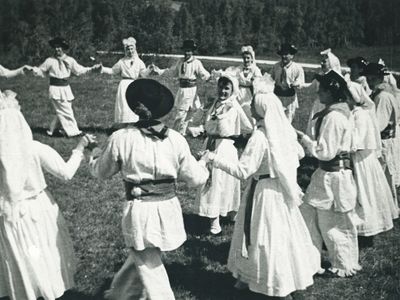 SPRING IN BELA KRAJINA
Milka and Metod Badjura, Yugoslavia (Slovenia), 1952, 14’, B&W, 35mm
White Carniola was one of the key strongholds of the National Liberation Struggle during the Second World War, where a people’s government was also established during the war. Yet most Slovenians knew little of this remote region along the Kolpa River, apart from what they had encountered in a handful of literary works. Milka and Metod Badjura were the first to bring images of its magnificent landscape, its people and their everyday lives, as well as one of Slovenia’s central folk traditions, jurjevanje, to Slovenian and Yugoslav audiences in this beautiful short film. Although they conceived and directed the film together, only Metod received the Prešeren Award for it in 1953. Three years later, they made a sequel together, Obnova v deželi svobode (1955), focusing on the post-war reconstruction and modernization of White Carniola.
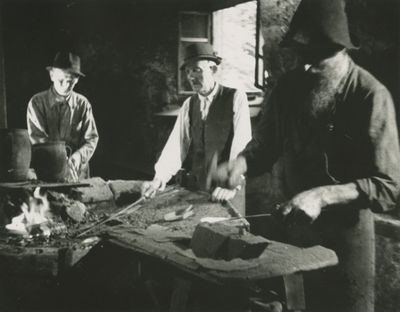 KROPA BLACKSMITHS
Milka and Metod Badjura, Jugoslavia (Slovenia), 1953, 14’, B&W, 35mm
The products of the blacksmiths from Kropa rank among Slovenia’s best-known artistic and craft masterpieces, with a tradition spanning several centuries. Alongside numerous works of art, Milka and Metod Badjura also trace the history of blacksmithing in Kropa, from the heavy toil of entire families in old peasant cottages to an organized and highly regarded craft practiced first in manufactories and later in modern workshops. They also highlight the importance of workers’ organization in the flourishing of the craft: as early as half a century before the advent of socialism, the blacksmiths of Kropa and their families had established their own nailmakers’ cooperative.
THE BRDA HILLS
Milka and Metod Badjura, Jugoslavia (Slovenia), 1960, 11’, color, 35’
A beautiful cinematic tribute to Goriška Brda and its people. In the film, Milka and Metod Badjura present Brda as a place of historic significance, a land of “a thousand years of resistance by the Slovenian people” and the “last line of defense of the homeland.” They also portray its natural beauty, folk traditions and art, as well as the agricultural work associated above all with the famed Brda cherries and the celebrated grapevines that remain a vital source of livelihood and a defining feature of the region to this day.
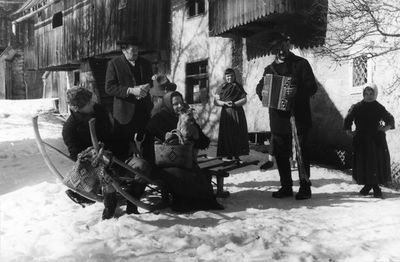 CAROLLERS
Milka and Metod Badjura, Jugoslavia (Slovenia), 1967, 13’, color, 35’
One of Milka and Metod Badjura’s boldest films, which transforms koledovanje—the New Year’s custom of going from house to house in the village—into an ode to human exuberance and revelry, while also showing, without embellishment, the Dionysian side of village traditions. Among the carolers appearing before the camera is Bojan Adamič, a legend of Slovenian film music, whose accordion playing and mischievous spirit set the rhythm for the increasingly boisterous company.
Four Seasons of a Female Cinema Pioneer
Milka Badjura (née Kunstler, 1902–1992), together with her husband Metod, left an indelible mark on Slovenian cinema—first as a pioneer and later as a master of film editing. Far less known, and even less widely acknowledged, is her contribution to researching and portraying Slovenian history, culture and geography. Even before the Second World War, the Badjuras, as amateur filmmakers, began exploring Slovenian customs and traditions. It was during this period that, even in temperatures as low as 28 degrees below zero, they made the celebrated Bloški smučarji (Skiers of Bloke, 1932), as well as the second Slovenian feature film, Triglavske strmine (The Slopes of Triglav, 1932), for which they climbed Triglav with a camera for the second time. Through their company Sava film, they laid the first foundations of serious film production in Slovenia, while Milka initially did her editing right in the kitchen—naturally, alongside all her other household chores.
“My path into Slovenian cinema began—oh, such a long time ago now. And it was my husband Metod who paved the way for me. I helped him with everything, sacrificed countless hours that were meant for housework and gave up many things so that we could make films. At first they were short and feeble, just as the preparations and equipment at our disposal were modest and inadequate. We had to live in a basement flat (the less said about which part served as the laboratory, the better), and in the kitchen I not only did the housework but also—edited our first films,” she recalled those difficult beginnings in an interview with the magazine Film, which spoke to her while she was editing the cult classic Vesna (1953). Journalist D. T. found it worth mentioning that he had expected to find a man at the editing table, but had found Milka instead.
The anecdote is telling not only of her own cinematic career, but also of the fate of countless women who remained overlooked beside celebrated male artists, even though they carried much of the burden of running the household and often contributed equally to their husbands’ careers. Milka experienced this herself in the very year that the great hit Vesna was released, a film that would hardly have retained its timeless appeal without her editing. Although Pomlad v Beli krajini (Springtime in White Carniola, 1952) was conceived and directed jointly by the two of them, only Metod received the Prešeren Award for it. And this was already in post-war socialist Yugoslavia, which had nevertheless granted women formal equality and at least partially freed them from confinement to the domestic sphere by providing them with employment and encouraging their professional participation.
And one of those women who experienced a genuine professional flourishing after the war was Milka Badjura. She edited more than one hundred short and feature films and, as Delo journalist Stanka Godnič writes, with her “sixth sense for putting things together”, and with “effort, dedication and conviction”, helped “many directors complete their cinematic message”. Her dedication is eloquently reflected in a statement she gave to the weekly 7D: “I never worked in the editing room for less than ten hours a day. If necessary, I would spend five days and nights in a row there; I knew neither family nor holidays just so that the film would be finished.” She also added that “directors never truly took the editor’s work into consideration, and even less so the instinct you either possess—or do not possess—innately.”
Nor did her commitment end there. Until her death, she fought for the preservation and proper presentation of the film heritage she had left behind with Metod, among other things by repeatedly visiting the Slovenian Film Archive. Its current head, Tatjana Rezec Stibilj, remembers this and, upon our announcement of this retrospective, she wrote: “I’m glad you have decided to screen the films from film prints. If anyone deserves it, it’s most certainly Milka Badjura.”
If Yugoslav cinema eventually did give her the recognition she deserved—in 1955, with the Yugoslav Cinematheque’s plaque for pioneering work in film; in 1968, with the Prešeren Fund Award as a pioneer and founder of the film editing profession; in 1969, with the Yugoslav Cinematheque’s plaque for documentary filmmakers; and finally, in 1985, with the Order of Merit for the Nation with Silver Rays of the SFRY—Slovenian film histories until relatively recently continued to treat her primarily as an appendage to her husband Metod, mentioning her only in passing or not at all.
This finally began to change just over a decade ago: when Ljubljana named a street after her; when Zdenko Vrdlovec, in his 2010 book Zgodovina slovenskega filma (History of Slovenian Film), presented her as an equal partner alongside Metod; and when, in 2023, the Slovenian Film Centre finally renamed its lifetime achievement award in film after both of them—an award that had previously borne only the name of Metod Badjura.
Today, because of this historical amnesia and the incompleteness of the surviving sources, it is practically impossible to disentangle the respective contributions and roles of Milka and Metod Badjura in their joint film projects. In the filmographies, some films—particularly those made before the war—are still credited to Metod alone for direction and screenwriting, while others from the post-war period list both of them—but never Milka alone. For this retrospective, we have therefore decided to present some of their finest short films in which Milka is also credited as director and screenwriter. Beyond the bibliographical details, they clearly reflect her exceptional feel for the film medium, for rhythm and for detail, bringing a great deal of vitality and authenticity to stories of remote Slovenian regions, ancient Slovenian customs, important traditions and distinctive people—qualities that make these films timeless and unforgettable.
Spring
The region of Bela Krajina (White Carniola) was one of the key centres of the National Liberation Struggle during the Second World War. It was here that a people’s government was established during the war, along with a cinema. Yet most Slovenes remained unfamiliar with this remote region along the Kolpa river for a long time, apart from what they encountered in a few literary works. Milka and Metod Badjura were the first to bring Bela krajina to Slovenes and Yugoslavs as early as 1933 with the short film Jurjevanje v Črnomlju (St. George’s Day Celebration in Črnomelj, 1933), and twenty years later they expanded on this work with the award-winning Pomlad v Beli krajini (Springtime in White Carniola, 1952).
This beautiful short film is a distinctive blend of France Marolt’s ethnological study, magnificent images of nature, the local people and their everyday lives, and one of Slovenia’s central folk traditions—jurjevanje, the celebration of St. George’s Day. It captures the idyllic springtime atmosphere of White Carniola and the ancient bond between its people and nature. Metod Badjura’s exquisite images, which capture the sunlight and joy of spring awakening, are complemented by Milka’s sensitive, rhythmically precise editing, which moves seamlessly between wide shots of the landscape, shots of people and details of their creative work. Add to this the fact that Milka edited Vesna (1953) the following year, and that three years later the Badjuras returned to White Carniola with their camera to document its post-war reconstruction and modernisation in Obnova v deželi svobode (Renovation in the Land of Freedom, 1955), and this period can undoubtedly be called her second spring—her cinematic one.
Summer
Although Kroparski kovači (Kropa Blacksmiths, 1954) belongs to the same period, it is completely different, both in content and form. It begins lightly, with children playing in summer in the clear waters of an Upper Carniola river, where they discover an unusual relic from the past that, through their father’s story, transports both them and us into Kropa’s fiery history.
That history is inseparably bound up with the arduous work of the blacksmiths, which over five centuries underwent extraordinary development in craft, artistic and social terms alike. The editing accordingly moves quickly, at times even roughly, like the iron being forged by strong hands, while the images are often as dark as the faces of the men and women working at the forges. Like Milka, who edited in the kitchen at the beginning of her career, these women would cook and look after their children while also working at the forge.
Alongside precise images of the work and lives of the blacksmith families, the film offers numerous details of Kropa’s products, which rank among the best-known examples of Slovenian artistic craftsmanship. The Badjuras also trace the historical arc of blacksmithing, from the gruelling labour imposed on entire families in old peasant cottages to organised and respected craftsmanship in manufactories and, eventually, the modern industrial workshop. They also highlight the importance of workers’ organisation, which helped the craft flourish: in Kropa, the blacksmiths and their families had established their own nail-making cooperative half a century before the advent of socialism.
Autumn
In 1960, the Badjuras also visited Goriška Brda, a hilly region in western Slovenia, giving it a beautiful cinematic monument with the simple title Brda. They present the historical significance of the hills as the “last sentry of the homeland”, their natural beauty, folk customs and art, but above all the work of the farmers, centred in particular on the celebrated cherries of Brda and its renowned vines, which remain crucial sources of livelihood and regional identity to this day.
Highly unusual for an ethnographic study, the film begins like an adventure movie: with tense film music, on a moving bus that crosses the bridge over the Soča river and then climbs a series of dizzying bends above it, until it reaches its first idyllic view of the blossoming cherry trees. Then, with a line by Alojz Gradnik—“It is spring, come with me to our hill”—it invites us to wander through the landscape and its history, across the border, among its people and their local delicacies.
But the beautiful spring soon gives way to the strenuous summer pruning of the vines and work in the vineyards, and the film naturally reaches its climax in autumn, when the vines and trees bear abundant fruit and the cheerful harvesting and tasting of the rewards of hard work begins. The fact that the authors entrusted the text for a film about such poetic places to one of Slovenia’s finest poets, Tone Pavček, is testament to their feel for the cinematic material they captured and edited into a beautiful whole.
Winter
The idyllic snow-covered Alps and an Upper Carniola village wrapped in snow and ice open one of Milka and Metod Badjura’s boldest films, Koledniki (Carol Singers, 1967). After such a peaceful, conventional opening, the viewer hardly expects what follows: a story about koledovanje—the New Year’s custom of going from house to house in the village—is transformed into an ode to human playfulness and revelry, while also showing, without embellishment, the Dionysian side of rural customs.
The vitality of the images and the rhythm of the editing intensify along with the revelry and drunkenness of the carol singers, and the film culminates in a hair-raising descent by sled. To provide the proper measure of authenticity, a camera is placed on the sled as well, filming from a first-person perspective. The Badjuras also put a legend of Slovenian film music, Bojan Adamič, in front of the camera as one of the carol singers. With his accordion and mischievous humour, he sets the rhythm for the increasingly exuberant group. In a supporting role appears the master blacksmith from Kropa, Joža Bertoncelj, who devised the story for the film.
Žiga Brdnik