




LUIGI DI GIANNI

OCTOBER 1 | 16.00
Kinemax Gorizia
Director Luigi Di Gianni
The cinematic and anthropological journey of Luigi Di Gianni (Naples, 1926 – Rome, 2019) represents one of the most original and rigorous trajectories in Italian documentary filmmaking. Although at the beginning of his career the director dreamed of fiction films, stories drawn from the crime pages and adaptations of Kafka’s anguished works, fate led him to radically redefine the relationship between the camera and the ethnographic investigation of popular traditions. Through his films, Di Gianni gives voice and dignity to all those marginalised lives that official history tended to forget. (Mila Lazić, curator)
In collaboration with Lucanian Cinematheque (Cineteca Lucana).
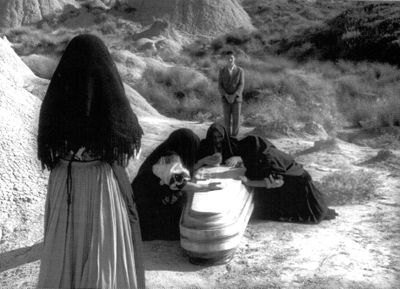
LUCANIAN MAGIC
1958, 19’
Inspired by the work of the renowned anthropologist and historian of religions Ernesto de Martino, Luigi Di Gianni sets out to trace surviving forms of magical practices in Lucania. His documentary debut, Lucanian Magic, is an investigative film exploring the magical-religious reality, traditions and rituals of the peasant population in the Italian region of Basilicata. Shot in black and white without sound, the film relies primarily on the expressive power of images. The voice-over, the ritual laments performed by prefiche (translator’s note: women who traditionally performed ritual wailing and mourning), and the music of the jaw harp were added only during the editing process.
The short film received the Grand Prize in the documentary category at the 19th Venice Film Festival.
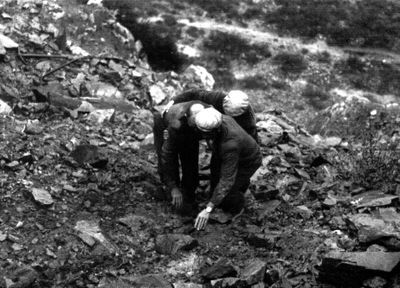
DANGER IN VALSINNI
1959, 13’
“Valsinni, a land long marked by constant devastation, yields little and offers no certainty to those who work it, whose labour is often seemingly futile and constantly threatened. Especially when the forces of nature run wild, the mountains split open and the slopes collapse all around. This is the story of a peasant family that loses its head of household while engaged in hard and thankless labour.”
A portrait that highlights human humility in the face of the power of nature.
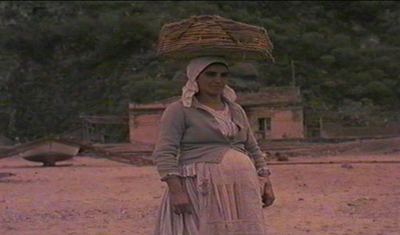 THE WOMEN OF BAGNARA
1959, 10’
The women of Bagnara Calabra, a town in the region of Calabria in southern Italy, were fearless workers, known for their imposing, almost sculpted physiques, as well as their pride and physical strength. While men were mainly engaged in fishing and maritime trade, women played a crucial role in the local economy. They undertook extremely strenuous work building retaining walls and defending the land, carrying heavy rocks and stones on their heads from the sea inland.
The film is an ode to the women of Calabria.
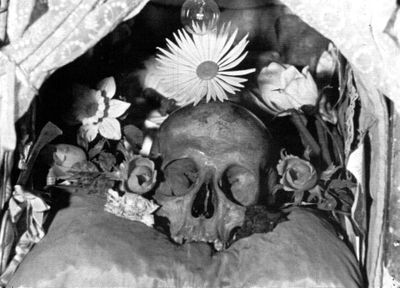 GRACE AND NUMBERS
1961, 15’
An intense film about the cult of the souls in Purgatory, deeply rooted in Neapolitan tradition, takes Di Gianni into the underground spaces of the hypogeum beneath the Church of Saint Augustine. Ancient beliefs and an eerie atmosphere intertwine with magic and superstition. The sacred and the profane, the Catholic and the pagan, coexist peacefully here within the same cultural tradition.
In this film, Di Gianni for the first time places short testimonies alongside the language of images. The film received an award at the 1963 Bergamo Festival of Auteur Cinema.
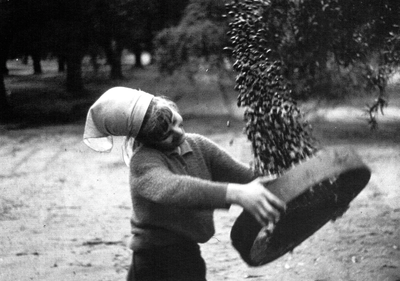 HARVEST TIME
1967, 13’
A social critique and a powerful portrayal of the exploitation of women picking olives in the Reggio Calabria area of southern Italy. The emigration of men to northern Italy and abroad led to the depopulation of villages, leaving women to shoulder the entire burden of supporting and caring for their families.
Their living conditions are harsh: without trade-union protection or medical care, they are left to exhausting labour. As a result, their bodies quickly weaken, become ill and age prematurely.
Very Difficult Subjects, but a Sure Hand
In Search of Luigi Di Gianni’s Cinema
The cinematic and anthropological journey of Luigi Di Gianni (Naples, 1926 – Rome, 2019) represents one of the most original and rigorous trajectories in Italian documentary filmmaking. Although at the beginning of his career the director dreamed of fiction films, stories drawn from the crime pages and adaptations of Kafka’s anguished works, fate led him to radically redefine the relationship between the camera and the ethnographic investigation of popular traditions. Through his films, Di Gianni gives voice and dignity to all those marginalised lives that official history tended to forget.
The origins of his poetics can be traced back to 1954, with L’arresto, his graduation film at the Centro Sperimentale di Cinematografia, based on the first chapter of Franz Kafka’s The Trial and presented at the Venice Film Festival. This debut proved to be a small masterpiece, evocative and shadowy, in which one could already glimpse the principal characteristics of the visual language Di Gianni would go on to develop throughout his long career. Working in a stark, high-contrast black and white, Di Gianni succeeded in conveying the absurdity of the bureaucratic apparatus of power and the protagonist’s claustrophobic anguish. It was during this screening that Luchino Visconti offered a laudatory verdict that remained impressed on the young filmmaker’s mind: “A very difficult subject, but a sure hand.”
This highly distinctive style has its roots in the films that had captivated him from a very young age: Carl Theodor Dreyer’s Vampyr, The Phantom of the Opera starring Lon Chaney, and the Expressionist films of Fritz Lang and Robert Wiene. These visual influences were joined by the existentialist philosophy of Luigi Pareyson and Martin Heidegger, his readings of Fyodor Dostoevsky, and his profound fascination with Franz Kafka’s unease. This rich intellectual background enabled the director to explore deeper themes such as the meaning of nothingness and man’s anguish in the face of his own destiny, elements that would become the leitmotif of his entire subsequent body of work.
I like darkness and anguish; they are absolutely congenial to me… That is probably one of the reasons why I liked Kafka. I came to Kafka through Dostoevsky, and then there are my knowledge, my acquaintances, my intellectual circles, the philosophy of existence. These are not exactly cheerful models of thought. The concept of nothingness, the concept of anguish, man as the sentinel of nothingness, man thrown into the world, and so on.
The real turning point came with his encounter with the anthropologist and scholar of religion Ernesto de Martino. Fascinated by his research into rural communities and magical rituals, the director decided to set pure fiction aside and devote himself to ethnographic documentary. Southern Italy thus became his chosen territory: an ancient world in which magic and funeral lamentations are not mere folkloric curiosities, but genuine cultural shields employed by local people to protect themselves from poverty and everyday suffering.
In 1958 he made Magia Lucana, his first documentary, setting out on a long, close-up journey through the Italian South. In these works, the idea of cinematic fiction does not disappear, but is transformed into a “fiction of reality”. For Di Gianni, documentary was not a cold, objective recording of the world, but rather a “noble pretext for making cinema”. What interested the filmmaker was reconstructing a reality that could engage directly with his own personal sensibility.
His connection with Lucania was also intimate and biographical: at just nine years of age, Di Gianni was deeply shaken and fascinated when he witnessed a traditional funeral for the first time, with its ritual lamentations by the mourners.
“For me, documentary is a noble pretext for making cinema. I am not particularly interested in a direct relationship with reality; I am interested in a constructed relationship with a reality that I choose, a reality that suits me. I loved the Lucanian peasants, with their terrible faces, marked by suffering yet immensely noble, faces that no longer exist today. Thus, the choice of subject is also a choice of affinity—apart from certain particular circumstances, such as the fact that I am of Lucanian origin and returned as a child to those villages, where certain things struck and moved me deeply, above all a funeral, to remain with that subject, with the funeral lament I witnessed. At the time I did not know what it was, and it truly left a deep impression on me.”
Di Gianni’s cinema does not merely record reality; it deciphers it. He transformed fieldwork into a total work of art, demonstrating how ethnographic documentary could rise to the level of the highest philosophical reflection on the human condition. Formally, he was interested in atmosphere, in the expressive possibilities of black and white, and in the arcane aspects of a mysterious reality. He attended to detail, recreating the dark, magical and unsettling atmospheres that resonate with his own sensibility. To capture the intensity of everyday life, he spent long periods on location with his small crew, becoming part of the local communities in order to elicit gestures that were spontaneous and natural.
His stylistic choices reflect the same meticulous care: the visual eloquence of the images comes first and determines the film’s sonic dimension, which is sought out and integrated only during the final editing stage.
Kafka has always followed me into my documentaries as well. I have always evoked him in the atmospheres, in the situations, even the grotesque ones. My interest in representing the outcasts, the powerless, is certainly Kafkaesque too, as is my desire to express through cinema my attachment to them.
His stylistic preference for close-ups imbues the faces and bodies of his protagonists with a Dreyerian, almost sacred atmosphere, transforming the stark depiction of extreme poverty into an epic fresco of the human condition.
The silent struggle between humble human beings and an often-hostile natural world is a constant that emerges in many of his films, including Nascita e morte nel meridione – San Cataldo, Frana in Lucania, Pericolo a Valsinni and Un paese che frana.
Di Gianni devoted particular attention to the strength of women left alone, forced to shoulder the burden of a heartbreaking everyday existence (Donne di Bagnara, Tempo di raccolta, L’annunziata). The camera often lingers on children, portraying them as they share the same precarious spaces as adults and animals in that raw, unfiltered rural world.
Di Gianni’s cinematic journey is a perpetual search in motion. He descends into the underground world of Naples to film the cult of the souls in Purgatory (Grazia e numeri, Morte e grazia). He travels to Sardinia to document an ancestral tradition of the pastoral world (La punidura). He makes his way through the Emilian Apennines to bear witness to life in a village under the threat of landslides (Un paese che frana), and travels as far as the Vajont area (La tragedia del Vajont, Vajont (Natale 1963)) to express his solidarity with a community struck by an immense hydrogeological disaster.
Many important documentary filmmakers of the period drew inspiration from De Martino’s research, but Luigi Di Gianni was the only one to remain faithful to it throughout his life, with extraordinary consistency. He demonstrated that ethnographic documentary is not a minor genre, but a supreme art form capable of prompting us to reflect on the human condition and on our relationship with time. His “sure hand” did more than simply film a world that was disappearing: it saved that world from oblivion, giving us a visual testimony destined to endure forever.
Mila Lazić