


CinemaEye: Luigi Di Gianni at Slovenian Cinematheque
Thursday, 5 November, at 8 pm | Slovenian Cinematheque
The cross-border film festival Tribute to a vision traditionally brings its programme to the Slovenian Cinematheque, where, on 5 November, it presents the section CinemaEye, a dialogue between Slovenian and Italian film heritage. The programme is organised in collaboration with the Italian Cultural Institute in Slovenia and brings to Ljubljana a selection of short films by Italian director Luigi Di Gianni, screened alongside works by Milka and Metod Badjura, familiar figures to Cinematheque audiences and pioneers of Slovenian cinema. A distinctive feature of the evening is the screening of 35 mm film prints: Di Gianni’s films come from the Cineteca di Bologna, while the Badjuras’ works are provided by the Slovenian Film Archives at the Archives of the Republic of Slovenia. Through moving images, archival collections and a shared commitment to preserving film heritage, Slovenian and Italian cinematic traditions intertwine once again in a dialogue that transcends time and borders.
Through a selection of short films by both filmmakers, we will reflect on the relationship between film, history and memory: what remains in an image when time disappears, and how can an archive become a space for a new way of seeing?
The programme will be introduced by curators Mila Lazić and Žiga Brdnik.
Milka Badjura: Pomlad v Beli Krajini (1952), Kroparski kovači (1953), Brda (1960), Koledniki (1967)
Luigi Di Gianni: Magia lucana (1958), Grazia e numeri (1962), Tempo di raccolta (1967), Il culto delle pietre (1967)
The films will be screened with Slovene subtitles.
Admission: €5 full price; €2.50 for Kinopolis Club members.
The programme is organised in collaboration with the Slovenian Cinematheque, the Italian Cultural Institute in Slovenia, the Cineteca di Bologna, the Slovenian Film Archives at the Archives of the Republic of Slovenia, and the Slovenian Film Centre.
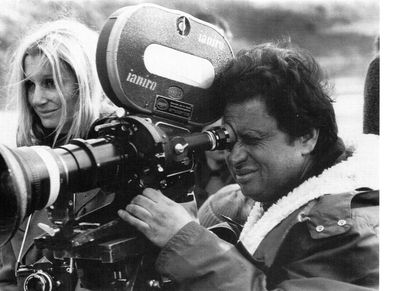
Director Luigi Di Gianni
The cinematic and anthropological journey of Luigi Di Gianni (Naples, 1926 – Rome, 2019) represents one of the most original and rigorous trajectories in Italian documentary filmmaking. Although at the beginning of his career the director dreamed of fiction films, stories drawn from the crime pages and adaptations of Kafka’s anguished works, fate led him to radically redefine the relationship between the camera and the ethnographic investigation of popular traditions. Through his films, Di Gianni gives voice and dignity to all those marginalised lives that official history tended to forget. (Mila Lazić, curator)
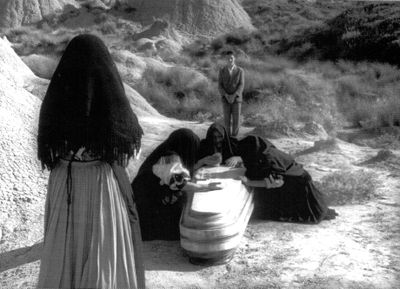
LUCANIAN MAGIC, 1958, 19’
Inspired by the work of the renowned anthropologist and historian of religions Ernesto de Martino, Luigi Di Gianni sets out to trace surviving forms of magical practices in Lucania. His documentary debut, Lucanian Magic, is an investigative film exploring the magical-religious reality, traditions and rituals of the peasant population in the Italian region of Basilicata. Shot in black and white without sound, the film relies primarily on the expressive power of images. The voice-over, the ritual laments performed by prefiche (translator’s note: women who traditionally performed ritual wailing and mourning), and the music of the jaw harp were added only during the editing process.
The short film received the Grand Prize in the documentary category at the 19th Venice Film Festival.
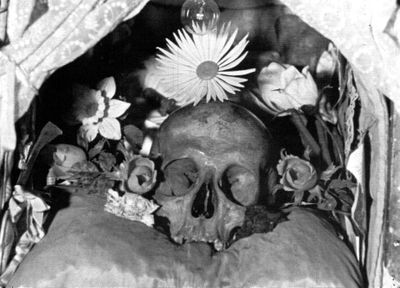
GRACE AND NUMBERS, 1961, 15’
An intense film about the cult of the souls in Purgatory, deeply rooted in Neapolitan tradition, takes Di Gianni into the underground spaces of the hypogeum beneath the Church of Saint Augustine. Ancient beliefs and an eerie atmosphere intertwine with magic and superstition. The sacred and the profane, the Catholic and the pagan, coexist peacefully here within the same cultural tradition.
In this film, Di Gianni for the first time places short testimonies alongside the language of images. The film received an award at the 1963 Bergamo Festival of Auteur Cinema.
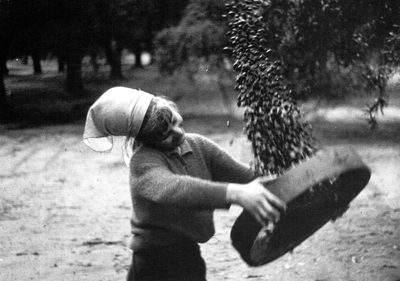
HARVEST TIME, 1967, 13’
A social critique and a powerful portrayal of the exploitation of women picking olives in the Reggio Calabria area of southern Italy. The emigration of men to northern Italy and abroad led to the depopulation of villages, leaving women to shoulder the entire burden of supporting and caring for their families.
Their living conditions are harsh: without trade-union protection or medical care, they are left to exhausting labour. As a result, their bodies quickly weaken, become ill and age prematurely.
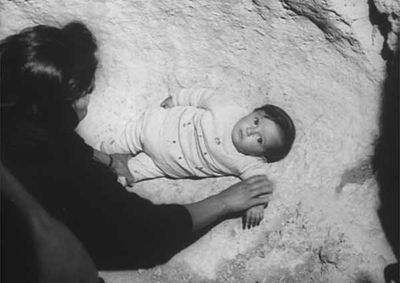
THE CULT OF STONES, 1967, 14 min
Near the town of Raiano in Abruzzo stands a secluded sanctuary. According to local tradition, Saint Venantius once lived in the caves nearby. Every year, on the saint’s feast day, pilgrims make their way to the caves and rub themselves against the rocks in the hope of being cured of their ailments. One of Luigi Di Gianni’s ethnographic masterpieces, the film explores a unique ritual practice found in many parts of central and southern Italy, where pagan beliefs and Catholic tradition intertwine. The film was restored by the Cineteca di Bologna in 2013.
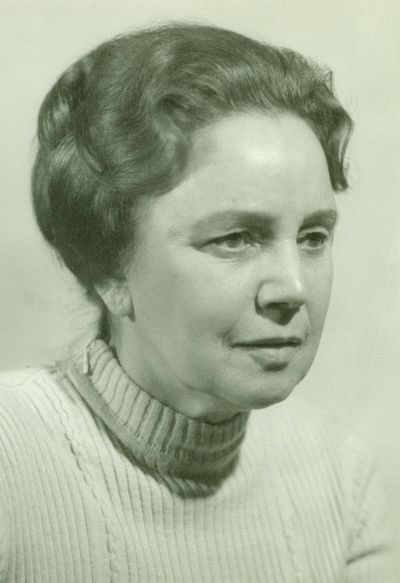
Director Milka Badjura
Milka Badjura (born Kunstler in 1902; died in 1992) left an indelible mark on Slovenian cinema alongside her husband, Metod – first as a pioneer and later as a master of film editing. Far less well known, however, is her contribution to researching and portraying Slovenian history, culture, and geography.
Even before the Second World War, the Badjuras began exploring Slovenian customs and traditions as amateur filmmakers. Through their company, Sava Film, they laid the foundations for the first serious film production in Slovenia. In the early days, Milka even did her editing in the kitchen – naturally, while taking care of all the other household chores. (Žiga Brdnik, curator)
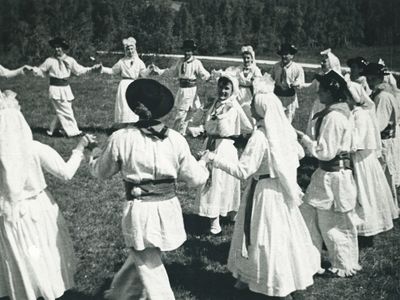
SPRING IN BELA KRAJINA, Milka and Metod Badjura, Yugoslavia (Slovenia), 1952, 14’, B&W, 35mm
White Carniola was one of the key strongholds of the National Liberation Struggle during the Second World War, where a people’s government was also established during the war. Yet most Slovenians knew little of this remote region along the Kolpa River, apart from what they had encountered in a handful of literary works. Milka and Metod Badjura were the first to bring images of its magnificent landscape, its people and their everyday lives, as well as one of Slovenia’s central folk traditions, jurjevanje, to Slovenian and Yugoslav audiences in this beautiful short film. Although they conceived and directed the film together, only Metod received the Prešeren Award for it in 1953. Three years later, they made a sequel together, Obnova v deželi svobode (1955), focusing on the post-war reconstruction and modernization of White Carniola.
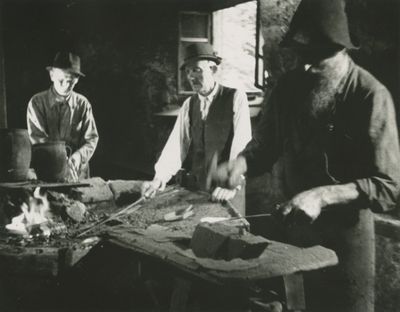
KROPA BLACKSMITHS, Milka and Metod Badjura, Jugoslavia (Slovenia), 1953, 14’, B&W, 35mm
The products of the blacksmiths from Kropa rank among Slovenia’s best-known artistic and craft masterpieces, with a tradition spanning several centuries. Alongside numerous works of art, Milka and Metod Badjura also trace the history of blacksmithing in Kropa, from the heavy toil of entire families in old peasant cottages to an organized and highly regarded craft practiced first in manufactories and later in modern workshops. They also highlight the importance of workers’ organization in the flourishing of the craft: as early as half a century before the advent of socialism, the blacksmiths of Kropa and their families had established their own nailmakers’ cooperative.
THE BRDA HILLS, Milka and Metod Badjura, Jugoslavia (Slovenia), 1960, 11’, color, 35’
A beautiful cinematic tribute to Goriška Brda and its people. In the film, Milka and Metod Badjura present Brda as a place of historic significance, a land of “a thousand years of resistance by the Slovenian people” and the “last line of defense of the homeland.” They also portray its natural beauty, folk traditions and art, as well as the agricultural work associated above all with the famed Brda cherries and the celebrated grapevines that remain a vital source of livelihood and a defining feature of the region to this day.
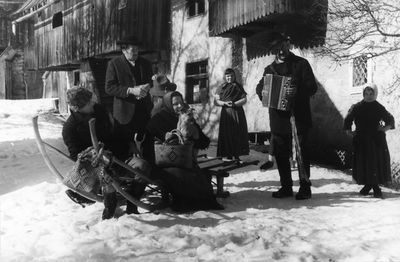
CAROLLERS, Milka and Metod Badjura, Jugoslavia (Slovenia), 1967, 13’, color, 35’
One of Milka and Metod Badjura’s boldest films, which transforms koledovanje—the New Year’s custom of going from house to house in the village—into an ode to human exuberance and revelry, while also showing, without embellishment, the Dionysian side of village traditions. Among the carolers appearing before the camera is Bojan Adamič, a legend of Slovenian film music, whose accordion playing and mischievous spirit set the rhythm for the increasingly boisterous company.