


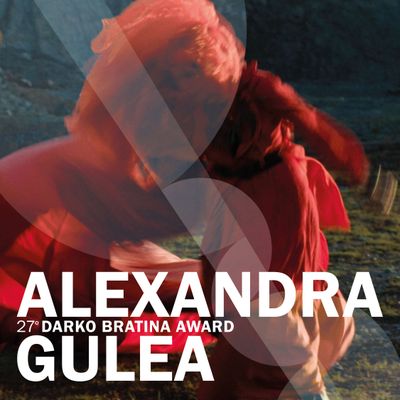
Alexandra Gulea

Director
2026
Motivation
Kinoatelje is awarding the 2026 Darko Bratina Award to Alexandra Gulea for her original body of work, in which a personal search for roots becomes a universal story about the deeper meaning of community, identity, and belonging. In her work, she weaves together performance art and anthropological research, personal inquiry and theatre of the absurd.
Her highly original reworking of an individual quest becomes a communal narrative and a collective touchstone against the chaos of nation-states that fail to give dignity to the communities that form them. In her delicate yet irreverent way, Gulea couldn’t care less about the homeland, patriarchy, nation-states or generally accepted truths of convenience; instead, her work takes us deep, getting to the heart of her personal quest for origins (familial and popular).
She hails from Romania, a country that has emerged as one of Europe’s most dynamic centres of cinema over the last twenty years, and has won numerous awards at major festivals. Gulea has dedicated much of her research to the culture of her country, exploring themes such as cultural hybridisation, mental distress, and music.
As the daughter and editor of one of Romania’s leading directors, Stere Gulea she has absorbed cinema as a natural language, one that has accompanied her throughout her life. Her cinematic language is that of the Lumière brothers, but also that of Méliès. The beauty she pursues through her films is rare — wild and sophisticated all at once.
Biography
Alexandra Gulea (1970, Bucharest, Romania) graduated cum laude in 1997 from the École Nationale Supérieure des Beaux-Arts in Paris. After participating in several painting exhibitions, she studied documentary filmmaking at the Munich Film School and since 1999 has directed documentary films, shorts, video installations, and feature fiction films. She has also worked as an editor on several movies.
Awardee's statement
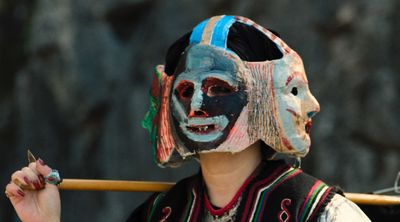
After seeing several of my works, one viewer described them as "social poems." Often conceived as group portraits, they function as small-scale, somewhat experimental pieces within the evolution of my artistic practice. They draw on marginalized communities, seeking to challenge the stereotypes through which these communities are categorized.
People living with mental illness, Roma musicians, miners' children, the Aromanian minority from which I come, stray horses. Where is the boundary between the person confined because of who they are, the person living with mental illness and "normality"? Do Roma musicians and their music transcend borders, while at the same time drawing inspiration from the folklore of the countries in which they live? Regarding the children of miners whose parents have become economic migrants and the children left behind in their country of origin, where does the boundary lie within the family, even across long distances? What is the boundary imposed on the "free" horses along the Romanian-Ukrainian border, the electric fences that block their access to water? And again, what does the border mean to my nomadic shepherd ancestors, former inhabitants of the Ottoman Empire? Their language, the Aromanian dialect that still survives, is the anchor of their culture, preventing them from becoming strangers within the cultures in which they live. The border creates a paradox: that of being both integrated and free at the same time.
Receiving the Darko Bratina Award at the Cross-Border Film Festival: Tribute to a Vision gives me the confidence to continue sharing and pursuing my explorations, which take as their starting point the realities of anonymous communities struggling to survive. Thank you for this recognition of my work. I am truly honored.
Selected filmography
Maia – Portret cu mâini (r. Alexandra Gulea, 2024, 90’)
Matei copil miner (r. Alexandra Gulea, 2013, 80’)
Dumnezeu la saxofon, dracu la vioara (r. Alexandra Gulea, 2004, 43’)
Moromeții 3 (r. Stere Gulea, 2024, 112’)
Azi eram frumoasă, jună (r. Alexandra Gulea, 2007, 52')
Valea Jiului - Notes (r. Alexandra Gulea, 2018, 13')