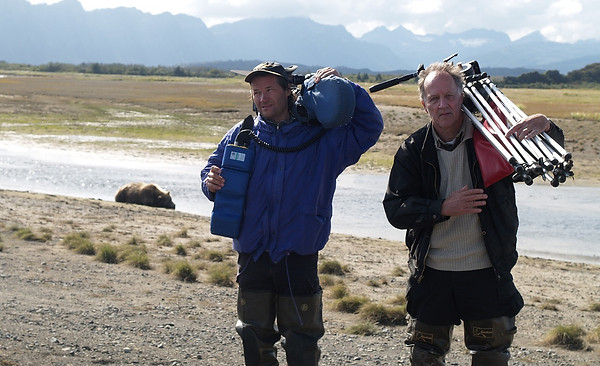


Peter Zeit Linger

Zeitlinger’s approach to cinematography goes back to the very beginning of the medium when it was still in rhythm with the world surrounding it and constantly developing ideas about how to capture situations. In his work the camera serves what is in front of it instead of creating its own reality. Zeitlinger embarks on journeys into unknown territories, be it to remote locations (the Chauvet Cave in Cave of Forgotten Dreams) or places shattered by history (devastated New Orleans after Hurricane Katrina in Bad Lieutenant: Port of Call New Orleans) in his work with Herzog
or into the abysses of the human (and Austrian) soul in his work with Ulrich Seidl (Tierische Liebe or Die letzten Männer, for example) or Helmut Grasser (Die Wahlkämpfer). More than once his camera captured the breaking points of emotions and ethical values. Yet, no matter if it concerns people being confronted with their traumatic past, dangerous animals, Nazism or trance like dream states, his images remain curious and never judgmental. In a world in which images are mostly made for “likes”, this is a welcoming reminder of the power of cinema.

Peter Zeitlinger was born on June 6, 1960 in Prague. In the wake of the 1968 Soviet occupation and the resulting political instabilities he had to leave the country. Together with his mother he settled in neighbouring Austria. After painting and sketching in his youth he discovered the 8mm format and created a couple of animation films. One of his first films, We Walked, was awarded a youth prize which helped him to gain a foothold in the Austrian film scene. Later, he was accepted at Filmakademie Wien where he rebelled against the teaching methods and where finally one of the most exciting and unusual careers of any European cinematographer took off. He also attended lectures at the Vienna philosophical institute and studied Management of Arts. After working on several fascinating projects with Götz Spielmann or Ulrich Seidl, filmmakers who today belong to the most important voices in Austrian cinema, Zeitlinger began working together with Werner Herzog. Their first joint effort was Death for Five Voices (1995), initiating a collaboration lasting until today that peaked in such incredible films as Encounters at the End of the World (2007) or Cave of Forgotten Dreams (2010). Together, Herzog and Zeitlinger repeatedly challenge the limits of cinema and find ways to make images of places that seemed impossible to film. Zeitlinger has been working as a cinematographer of fiction features, documentary features, shorts, tv-films and tv-series. However, he also contributed exceptionally in other departments, for example as a scriptwriter and editor. During his university years he had already written a number of scripts. One of the scripts co-written with Erhard Riedlsperger was Tunnelkind. The film has a personal connotation as it is set at the Czech-Austrian border where the Iron Curtain was erected during the late 60s. His finds cinematographic inspirations in smaller, intimate projects as well as when he films big Hollywood stars like Nicole Kidman or Nicolas Cage.
Zeitlinger has also been working as a director since 1978. He directed approximately 20 films, many of them shorts. In recent years Zeitlinger has intensified his collaboration with his partner Silvia Zeitlinger Vas as well as pursuing international production with idiosyncratic filmmakers such as James Franco or Abel Ferrara. He also has been a teacher at the Universität Mozarteum in Salzburg and the HFF Munich.